
Katy Black, marketing director at Verona Group reflects on the changes that the tiling industry has experienced over the last 25 years and the trends in the market.
THIS May, we’re celebrating being in business for 25 years, so I thought now would be the perfect time to reflect on some of the many changes we’ve seen in our industry since Verona first began life as the Mosaic Tile Company in 2001. Over the past 25 years, the UK tile industry has undergone a significant transformation, evolving from a largely functional category into one that’s increasingly design-led and technically advanced. While tiles have always played a practical role within domestic and commercial spaces, today they’re just as likely to be specified for their aesthetic impact as for their durability.
One of the most notable shifts we’ve seen as a company is in tile materials. Where natural stone and mosaics were once our forte – selling thousands of metres of travertine, marble and natural split face tiles – our range is now dominated by porcelain and ceramic, as we’ve adapted to suit market trends and customer demand. The introduction of high-definition inkjet printing in the mid to late 2000s revolutionised tile design, allowing manufacturers to replicate natural materials such as stone, marble and wood with far greater realism and variation. As a result, porcelain tiles have become a practical and cost-effective alternative to natural materials, offering consistency, durability and ease of maintenance without compromising on appearance.
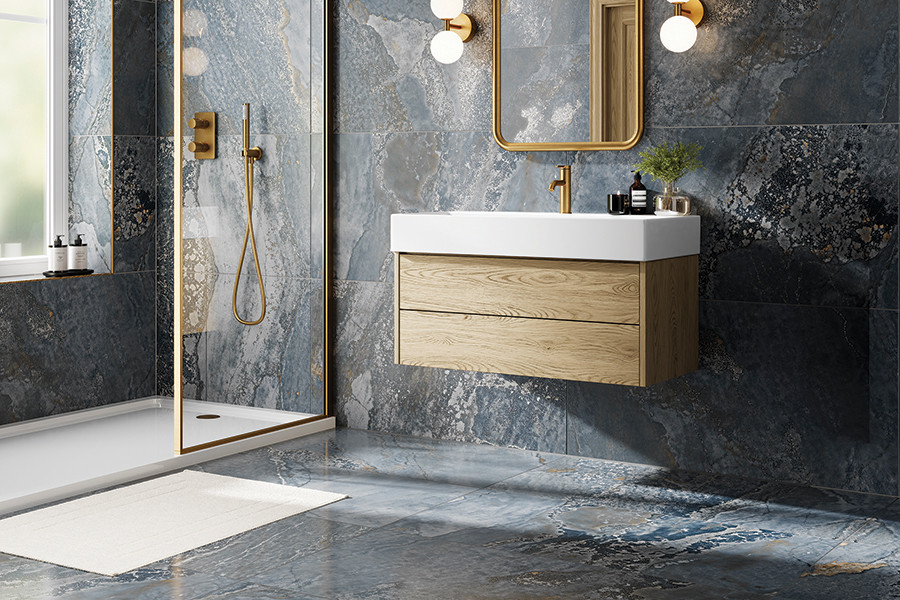
25 years ago, smaller ceramic tiles dominated the market, often in more traditional styles. I began my tile career at Ceramic Prints, and I still remember the number of people dedicated to hand painting decors such as baskets of fruit. Today, designs have moved away from being overly intricate, with styles that replicate marble, stone and onyx now leading the way. Tile sizes have increased too. 60x60cm, which was once seen as large format, is now widely considered an entry point, with 60x120cm and even larger slab formats becoming increasingly common. However, we’re seeing smaller tiles making a comeback, particularly in elongated formats and rustic finishes. Maybe not the baskets of fruit just yet though.
The influence of European manufacturers, particularly those in Italy and Spain, has played a key role in shaping UK design trends. Their focus on innovation and style has driven the market forward, with UK suppliers increasingly looking overseas for inspiration as well as product sourcing. This has contributed to a more design-conscious customer base, with homeowners and specifiers placing greater emphasis on finish, texture and overall aesthetic.
Beyond design, the structure of the industry itself has changed considerably. The sad demise of UK tile manufacturing has meant that the market is now far more reliant on imported tiles, with global supply chains playing a crucial role in product availability and pricing. More recently, factors such as Brexit, global conflicts and ongoing logistical challenges have highlighted the importance of strong supplier relationships and careful stock management.
At the same time, there’s been a shift in how tiles are sold. At Verona, we’re seeing fewer traditional tile shops, and an increase in boutique bathroom and kitchen showrooms offering a complete package, including wall and floorcoverings. The rise in ecommerce since 2001 has also influenced the tile market, with many customers now browsing and even buying tiles without leaving their home. When they do visit showrooms, consumers are often more informed than ever, arriving with clear ideas influenced by social media. I recently asked our new marketing co-ordinator where she would start if she was choosing tiles. Her answer? TikTok!
Sustainability is another area that has come into sharper focus in recent years. Tile production is energy-intensive, and both manufacturers and suppliers are under increasing pressure to improve their environmental credentials. This includes everything from more efficient manufacturing processes to the use of recycled materials and clearer product certification. At Verona, this is something we’ve really focused on over the last few years. We’re now part of the TTA Sustainability Working Group, as well as being a silver member of the Supply Chain Sustainability School (SCSS), and we’re proud to say we’re on track to meet our carbon reduction targets.
Looking ahead, the UK tile industry will keep evolving – as will Verona. Innovation in design and technology, combined with a growing emphasis on sustainability and performance, will continue to shape the market. What is clear is that tiles are no longer viewed simply as a practical surface covering, but as an integral part of the overall design scheme, with a role that is only set to expand further in the years to come.