
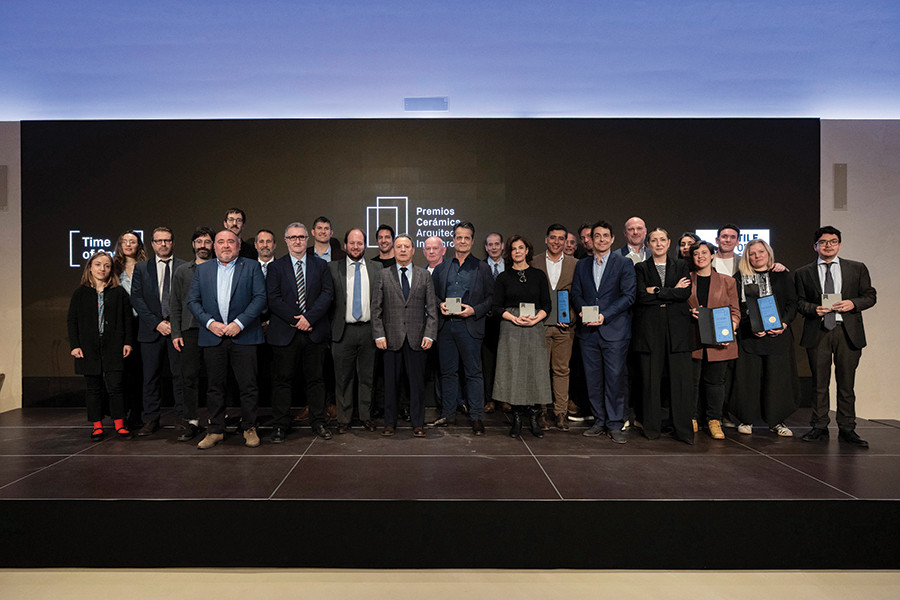
Tile and Stone Journal is delighted to announce that the publication has been awarded the international media award in the media outlet category at the Tile of Spain Awards earlier this year.
FROM the 23-25 February, Tile and Stone Journal among 47 other journalists in the tiling industry, were invited to a press trip hosted by Tile of Spain to Valenica as part of its new Time of Spain project, a promotional initiative for the tile and ceramic sector that takes place between February and March.
The trip involved visits to some of the key brand showrooms and factories in Castellon, the Tile of Spain Awards ceremony and a press conference. On behalf of Tile and Stone Journal, CEO of Kick-Start Publishing Johnny Miller attended to represent the magazine.
ASCER, the Spanish Ceramic Tile Manufacturers’ Association, who organises and promotes the Tile of Spain Awards at Castellón presented the award alongside the annual prestigious Tile of Spain Architecture Awards, celebrating projects that make outstanding use of ceramic floor and wall tiles manufactured in Spain.
Sponsored by the Port Authority of Valencia and supported by the Regional Ministry of Finance and Economic Affairs of the Generalitat Valenciana, the Tile of Spain Awards recognise outstanding architectural works, interior design projects, and master’s theses that showcase ceramic floor and wall tiles manufactured by ASCER member companies.
For the first time ever, the awards have introduced subcategories in Architecture (A-a, A-b) and Interior Design (I-a, I-b), each awarding a first prize of €8,000, while the Master’s Thesis category for architecture students offers a prize of €3,000.
Additionally, awards are granted to a national and an international media outlet in recognition of their contribution and promotion of Spanish ceramics.
This year, the international media award was granted to Tile and Stone Journal by ICEX Spain Trade and Investment, while the national media award went to the magazine Arquitectura y Diseño.
CEO Johnny Miller said: ‘I’m truly honoured to accept this award on behalf of my amazing editorial team and to be surrounded by so many creative people. To be recognised for international journalism by Tile of Spain – the gold standard of our industry – is a profound privilege.
‘I’ll never forget my visit to Castellón de la Plana. Being able to stand at so many places which show remarkable craftsmanship and ingenuity.
‘I was struck by the incredible contrast: on one hand, you have this massive, cutting-edge industrial power, and on the other, a meticulous, almost poetic attention to detail.
‘It was there I realised that ‘Made in Spain’ isn’t just a label; it’s a commitment to a heritage that dates back centuries, mixed with an obsession for future innovation. As for our journalists at Tile and Stone Journal, their goal has always been to capture that spirit-to show our readers that behind every ceramic slab or stone tile is a story of tradition, family, and immense pride. For me it’s always about the people behind the story. Spain has had a centuries old tradition of leading the tiling industry, it almost goes without saying.
‘Thank you to Tile of Spain and my editors of Tile and Stone Journal – both Lauren McCarthy and Harriet Whitaker. Reporting on this industry is a unique privilege because it allows us to bridge the gap between ancient tradition and modern innovation. This award belongs to every designer, manufacturer, and artisan whose work gives us such rich material to write about. I’m incredibly proud to be part of this international community.
‘Thank you to the jury, to ASCER, and to the people of Castellón for giving me such a beautiful story to tell.’
Lauren McCarthy, former editor of Tile and Stone Journal added: ‘It’s an immense honour for Tile and Stone Journal to be recognised with this award from Tile of Spain. It has long been an objective of the magazine to promote not just the commercial value of tiles but their beauty and artistry too, and Spain’s fantastic manufacturers have made this task an easy and enjoyable one. I’m grateful to the whole TSJ team, particularly our acting editor, Harriet Whitaker, who has consistently and eloquently championed the innumerable positive qualities of Spanish tiles.’
Harriet Whitaker, acting editor of Tile and Stone Journal commented: ‘Spain is one of the main countries that is heavily relied upon for its authentic, beautifully crafted tiles worldwide. Tile and Stone Journal have always been inspired by the skills of the Spanish manufacturers that encapsulate their tiles from beginning to end with quality and have always endeavoured to showcase them through the publication to its readers. I’m incredibly proud of the team, specifically Lauren who set a very high standard at Tile and Stone Journal and had a big influence on the magazine’s voice and direction. She brought real vision to the title and did so much to highlight all aspects of the industry. To have our work acknowledged by Tile of Spain and ASCER is a real privilege, and it reflects the passion and commitment of Tile and Stone Journal for for championing quality, design and innovation within our sector.’
Among the winners of the Architecture Awards category included Subcategory Aa winner, Casa Marratxí project by Casas inHAUS. The project was honoured for its seamless integration of ceramic tiles into an industrialised constructive system. The uniform use of the material throughout interior and exterior spaces reinforces the modular housing concept and the potential of ceramics in prefabrication processes.
Subcategory Ab winner was the Interventions at the Monastery of Santa María de Sijena by Pemán y Franco Arquitectos and Sebastián Arquitectos. It was recognised for the elegance and sensitivity of a restoration that honours the historic heritage. The subtle use of ceramic floor enhances the existing architecture without overshadowing it.
Interior Design Award winners included Subcategory Ia winner, The Brickell Penthouse Miami by François Guglielmina (TOGU Miami Design). It was acknowledged for its neo-pop, urban-inspired interior design concept, where natural light is integrated as a design element. Large-format ceramic surfaces add dynamism and brightness, making it the centerpiece of the design.
Subcategory Ib Il Mio Design’s Boc Beach project was awarded for its creative approach and the prominent role of colour and ceramic textures in the design. The various ceramic formats enhance the space’s identity and enable a smooth transition between indoors and outdoors.
The Master’s Thesis Award was granted to Manos Cerámicas by Manuel Alexander Fustamante Mori from CEU San Pablo University in Madrid, for its comprehensive homage to ceramics. The project stood out for its respect for traditional architecture and for using the ceramic process as a driving force in an intervention that revitalises the heritage of the village Los Loros, in La Gomera.
Reflecting on what winning a Tile of Spain Award meant, the team behind Casa Marratxí said: ‘I value this award very highly because it reflects not only ceramic tiles themselves, but the whole Spanish ceramic ecosystem. The industry is transforming the traditional way of building into a much more industrialised process, while still keeping design, systems, materials and craftsmanship at its core.
‘In our factory, we’re trying to do something similar: take traditional construction knowledge and move it into a factory environment with modular systems and new methods, without losing the essence of architecture. That’s why this award is so meaningful for us. It’s also a very international award, which makes it even more special.’
Representing Tile and Stone Journal at the awards, Kick-Start Publishing CEO Johnny Miller also took part in Tile of Spain’s press itinerary, which included visits to Castellón de la Plana, the international press conference, and leading Spanish tile manufacturers. The trip offered valuable insight into the heritage and innovation of the Spanish ceramics sector, as well as the scale of its international reach and continued importance to the UK market.
Some of the places visited at Castellón de la Plana included Raval Square (San José), Font de Dins (Market Square), Carrer and casa de Dalt, Church of Santa María, Valencia Street, and La Campana Factory.
The International Press Conference Centre was also a crucial part of the trip. ASCER presented its provisional end-of-year review for 2025. The international press conference was attended by 100 people, including many international press representatives.
Some of the key takeaways included the provisional end-of-year statistics for 2025, based on estimated data. It had a turnover of 4,834 million euros (+1%), with exports worth 3,484 million euros (+0.2%) and domestic sales totalling 1,350 million euros (+3.1%)1. Production rose by 2.7% to a figure of 427 million sq m according to data by the Institute for Industrial Productivity, and employment also rose by 1.4% with an estimated 15,939 direct jobs.
Attendees of the press trip were also given chance to visit tile manufacturers’ Porcelanosa and Natucer.
Johnny reflects: ‘On each visit to a manufacturer, I was envisaging their product all around my home. Marvellous. What struck me in all visits was the beautiful tiles were truly breathtaking and none of the craftsmanship is lost.
Porcelanosa has a massive manufacturing site in Onda, where just about everything is controlled by robots, with a sprinkling of staff running around on bicycles, making sure everything is running well. In lockdown an investment of over £50m was placed into the company and now it’s now reaping the rewards.’
He added: ‘Natucer is also based in Onda. It was more of what I would describe as a traditional manufacturer – reliant on manpower and automation, but very flexible in terms of order sizes, runs, colours etc. It was fascinating to see these manufacturing processes close-up and how focussed all the manufacturers are into recycling offcuts, broken tiles, tiles that don’t quite make the quality criteria etc – it’s amazing how literally nothing goes to waste. It’s a big tick for their environmental credentials right across the industry.’
The last part of the trip included a presentation of the current trends in Spanish tiling. The Spanish ceramic tile trends for 2026 are described to reflect a move towards more emotional, sensory and identity-led interiors, with Spanish manufacturers continuing to innovate while staying connected to Mediterranean roots, material quality and craft expertise, says Tile of Spain.
The first key trend, Geomatter, focuses on reconnecting with the earth through mineral textures, geological layers, patinas, natural reliefs and honest, tactile finishes. It’s said to celebrate imperfection, erosion and the physical beauty of raw materials.
Innerland responds to a need for calm and wellbeing, creating softer, more immersive spaces. This trend is said to use delicate textures, gentle colours and wraparound finishes to make interiors feel comforting, serene and emotionally restorative.
Heritage Play revisits the past through a contemporary lens, bringing together traditional patterns, artisanal influences, nostalgic colour and playful design. It’s said to position ceramics as a creative tool for expressive, characterful interiors.
Finally, Opulis is said to explore a more dramatic form of sophistication, with rich textures, depth, relief, fine finishes and visually intense surfaces. It presents ceramic tiles as a means of adding elegance, personality and sensory impact.
Together, the trends show Spanish tiles moving beyond function, towards surfaces that reconnect, comfort, express and seduce, says Tile of Spain.
Reflecting on his experience of the press trip, Johhny said: ‘What a fabulous experience, thank you Tile of Spain – I learned a great deal. Interestingly, all the international journalists I spoke to found the trip invaluable. What was particularly impressive was Tile of Spain put this trip together with just two months’ notice – incredible – you should be very proud of a fantastic itinerary and it was an honour to meet so many people, really committed to tile, design, colour and the traditions of Spanish Tilemakers who always give and out the traditions and craftmanship of times gone by.
‘Tiling in Spain is on a very firm footing.’
tileofspain.com/en/