
This month, TSJ speaks with Jesús Beredas of Be TM Design, a tile agent for Spanish factories in the UK. With a career spanning over 20 years, Jesús has many insights into how the tiling industry has changed over the decades, and perhaps more importantly, how it might change further in the coming years.
Q: Please tell us a bit about your background.
A: I finished university in 2001 and straight into the industry. I started at INALCO, considered a top brand at the time, a great place for me to begin. I was looking after the American market.
After that, I moved to Fanal Cerámicas, where I spent around eight and a half years, mainly EU markets, including both UK and Ireland.
In 2014, I felt it was the right time for a change, so I started my own agency in September of that year. I reached a collaboration agreement with Fanal to represent them in Ireland. That relationship continues today, and I still feel very grateful for the opportunity.
Early 2015, I also started developing the UK market, working on my own and with just one factory, Todagres. The business gradually evolved with the addition of new brands. Over the Years some factories, like Todagres, unfortunately went into liquidation, while others have been very successful for us.
That brings us to today — almost 25 years in the tile industry and more than 10 years running my own agency and proudly representing a great factories portfolio. Aiming to work with same in both Uk & IE.
Q: What have been the biggest changes in the market during your career?
A: Today, the industry has been completely transformed by digital technology. With digital printing, advanced pressing systems and increasingly similar production lines, most manufacturers are now able to produce reasonable to high-quality material. The clear distinction between “good” and “bad” producers has largely disappeared.
As a result, it is much more difficult to differentiate a product on technical grounds alone. Some factories still stand out through innovation, such as advanced 3D textures or highly realistic natural finishes, but today the real difference lies in the overall offer. It is about the image a company projects, its merchandising, showroom presentation, service, and the strength of its complete program.
Competition has also increased dramatically. In the past, the focus was mainly on a few key countries such as Italy, and later China. Today, with globalisation, the landscape is far broader and far more competitive, with strong producers emerging from many different regions around the world. What was once a relatively concentrated industry, is now a competitive global one.
Many UK customers say there have been more changes in the industry in the last 18 months than in the previous 18 years. Whether it’s Brexit, government policy or a generally flat market, there’s still quite a bit of uncertainty around.
On top of that, the rising cost of living and, post-Covid, a shift in priorities — with people valuing more free time, travel and holidays — has also impacted demand and behaviour in the market.
Some companies have already closed down, and there is, unfortunately, an expectation of further casualties and more consolidation.
Given the current situation, and the fact that there always seems to be something going on in the world, I keep telling myself every December: “Next year I will reduce my traveling and spend more time with my family”. In reality, I always end up doing the opposite.
Q: How do you approach the market as an agent?
A: I try to act as an extension of the factories I represent — almost as if I were part of their own team, basically their local presence in the market.
When I first started as an agent, I didn’t have the luxury of choosing an ideal portfolio. You take what you can get and build from there, which is very challenging at the beginning. I started in the UK with almost no factories at all.
Today, we offer a balanced portfolio that covers the full spectrum of the market — from large slabs to 100% recycled glass mosaics, from high-end specialist factories to high-volume producers.
Service and attention are extremely important to me. I travel constantly to visit customers. Always try to respond the same day. In this business, things are rarely black and white, so I never say no upfront. Together with the factories, we always look for solutions — bespoke finishes, product adaptations, slip ratings… etc. Ad hoc exclusive ranges, been growing in recent years.
We also place a strong focus on service and support. When issues arise, we step in quickly, take responsibility, and do our best to get it smoothly resolved. In the end, it’s not just about selling — it’s about how you stand behind what you do.
When our customers visit Spain, we help organise everything — transport, accommodation and factory visits — so they can focus on the experience. Next year, I’m also planning to organize a sports and charity weekend in Benicàssim, with a challenging 10K and half marathon along the beach.
I truly believe in being close to the people you work with, so since I’m based in Castellón, I’m constantly visiting factories, discovering new developments, discussing special projects, exploring new opportunities and planning market strategy together.
The company name reflects that philosophy too. We used to trade different name, but a few years ago, we changed the name to Be TM. The idea behind it is simple: “be team” — we win together and lose together. At the same time, the initials also represent my children names: “Thiago and Manuela”.
Q: What kind of customers do you work with?
A: We work with all kinds of customers and always try to keep a good balance. That includes online retailers, DIY chains, independent retailers, long-established family businesses, regional & national distributors.
That balance is important because factories need both the big players and the independents. At the same time, the industry is definitely changing. There are fewer independent retailers than before, and we’re seeing more acquisitions and consolidation — similar what we have seen with the Spanish Producers.
Over the years I have spent a lot of time on the architectural (A&D Community) side of the business. It can be a long process — sometimes you hear nothing for months, and then suddenly, a year and a half later, a major project comes through.
Today, Be TM has grown to a team of three people, something I am really proud of. Myself, my wife helping with the day-to-day operations, and Carmen, with the commercial back-office side of the business.
Q: What are UK customers looking for in terms of style?
A: Small formats remain very popular in the UK, especially bricks and other compact sizes. Patterned and encaustic-style tiles also continue to sell strongly, despite many predictions years ago that they would decline.
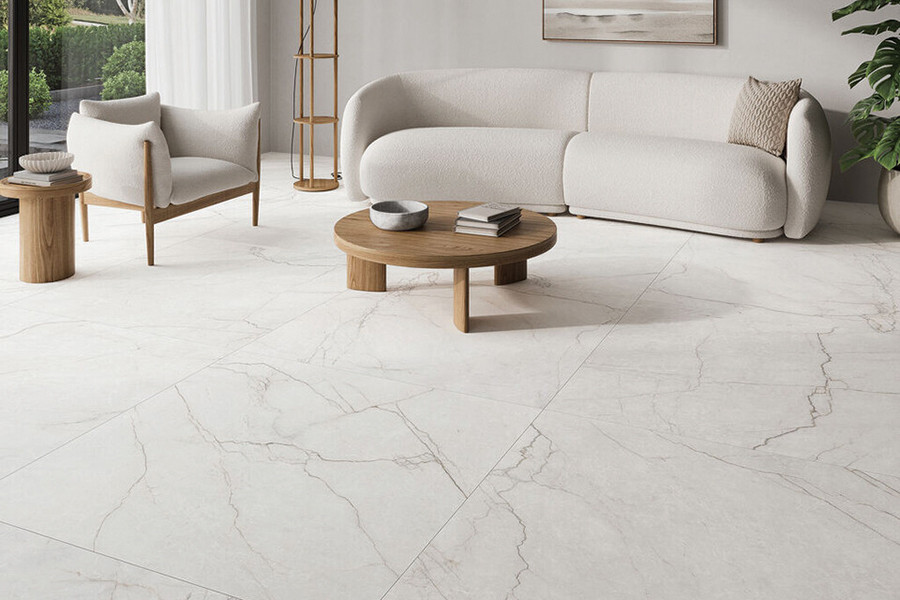
Customers are now faced with an overwhelming amount of choice, which makes it harder to create real excitement unless something feels genuinely different. One of the biggest shifts we’re seeing is the move away from grey tiles. Today, the market is dominated by warm-cream tones.
For years, people talked about terracotta and cotto looks becoming a trend, and now we’re finally starting to see real demand for those styles in the UK as well. Still a niche compared with Mediterranean markets, but growing.
Historically, it’s been more stone look, while Mediterranean countries preferred warmer and more colorful palettes. Spain, for example, traditionally didn’t use many small-format tiles and now it’s a big thing.
Q: What are the biggest challenges in the UK tile market?
A: The market is very flat at the moment, and many people feel the current UK government has not helped businesses. Whoever you speak to in our industry will agree that trading conditions are challenging.
Almost every customer says business is down by 10–15%, and it’s rare to hear companies reporting any real growth. Footfall is down, demand is softer, and overall the market feels quite tough.
That’s why my approach is to keep pushing, stay positive, and focus on offering along with products, services with real added value, specifically adapted to the UK market. It’s no longer enough to simply launch a new tile — you need to build a story around the product and clearly explain why it fits the market.
Q: Is the importance of sustainability still growing in the tile industry?
A: Yes, sustainability has definitely been growing. It has already been a key factor and a must for years in the contract and architectural side of the business. Now it is becoming more important across the General market.
If we can offer products with recycled content, that adds clear additional value. We encourage the factories we work with to continue improve their sustainability practices and environmental standards and proof evidence with more Certifications.
Q: Finally, what message would you like to promote to the industry?
A: The industry has changed a lot. Tiles don’t sell themselves the way they did 20 years ago, so we’ve had to evolve — especially through social media, websites, AI, and digital marketing.
Younger generations simply buy differently, which means the industry needs to embrace platforms like TikTok, influencers, and new digital tools. I’m not really familiar with all of that myself, to be honest, but it’s clear that it’s becoming part of how the market moves. We also need to fully understand and integrate AI into the way we work, because things are moving incredibly fast.
Today, companies need to be more proactive, react faster, and bring products to market ahead of competitors. It’s not so much about inventing something completely new — most things already exist in the industry — but about how you present and sell them compared to just a few years ago.
Customers increasingly expect more interactive experiences, where they can almost “feel” the tile online before buying it. The industry has to adapt to that reality.
Of course, there will always be challenges — whether geopolitical issues, economic uncertainty, or market pressure. The key is to stay agile, adapt quickly, and keep pushing forward.
Jesús Beredas
34 637798412 – jesus@btm.es
Carmen Maria Escobar
34 697312287 – carmen@betm.es