
Underfloor heating (UFH), whether water or electric, offers significant advantages over traditional radiator systems, primarily due to how it distributes heat. Instead of using convection to heat the air locally, it uses radiant heat across the entire floor surface to warm the room evenly from the ground up.
Further benefits include high energy efficiency, reduced heating bills, better control, low maintenance, zoned temperature, maximisation of space and increased freedom of design.
However tiling over underfloor heating introduces specific challenges, mainly due to the fact that the assembly undergoes frequent cycles of thermal expansion and contraction. If these forces are not properly managed, they can quickly lead to cracked grout lines, fractured tiles and complete adhesive failure.
As the floor heats up and cools down, the substrate and the tiles may expand and contract at different rates. Without a way to absorb this movement, the stress transfers directly into the tiles, causing them to crack or tent up.
Adhesive or grout failure can be caused by using non-flexible products which can lead the adhesive bond to become brittle and snap under thermal strain. Additionally, newly laid concrete or screed contains large amounts of moisture. This must be allowed to dry adequately or the adhesive bond will weaken and the tiles may debond. Finally, if the adhesive layer has gaps or voids underneath the tiles, heat will not transfer evenly and the tile above may flex and experience hairline fractures.
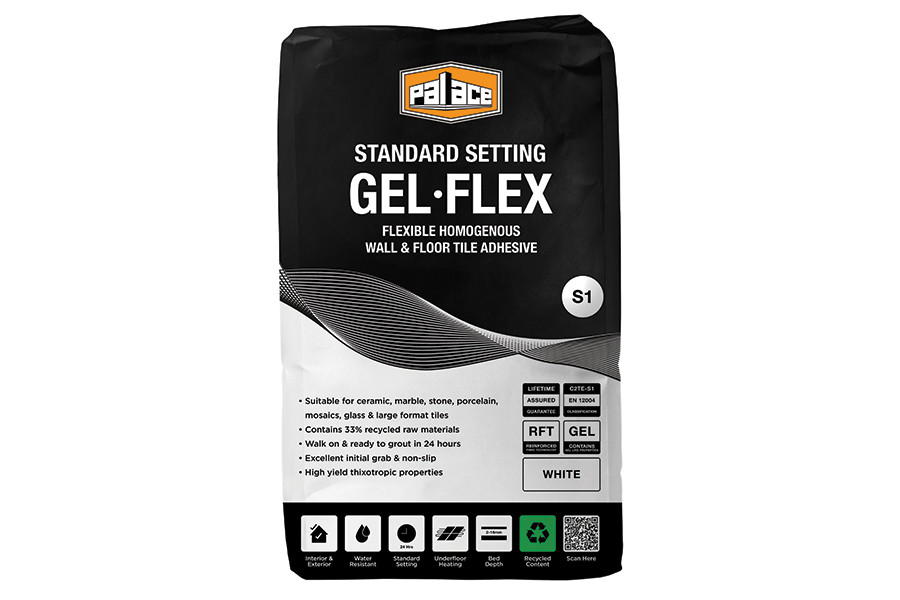
From Palace’s extensive range of powdered adhesives, GEL-FLEX is specifically recommended for use with UFH systems on account of its highly polymer-modified properties, which enable it to provide high levels of flexibility and an ability to tolerate movement in the substrate.
It is a standard setting, flexible homogenous cement-based tile adhesive, which features fibre reinforcement based on Reinforced Fibre Technology (RFT), says Palace. It provides a high bond strength and instant grab, the company says, which is essential when fixing ceramic, marble, natural stone, mosaic, porcelain and large format tiles especially in internal floors incorporating UFH.
The product’s thixotropic properties have the benefit of increasing both working time and improved instant wet contact and open time with the tile back. This reportedly makes it more straightforward to reposition tiles during the bonding process, contributing to the accuracy and quality of the finished installation. Thixotropic properties reportedly make the adhesive fully bodied and static at rest, which prevents slip, and helps hold heavy or large tiles firmly in place once positioned.
It also has polymer-modified characteristics, which provide the flexibility and S1 deformation to enable it to handle the heating and cooling cycles encountered with UFH.
By the end of the year, GEL-FLEX will be available in three different versions – Standard Set, Semi-Rapid and Rapid Set.
“This is the type of adhesive which today’s tiling market is looking for,” explains Palace commercial director Steve Ball. “The product is being very well-received by the market, in part because it is very easy to mix and work with. Tile fixers will find it is easy to apply and it has a smooth creamy texture which, according to our testing, is a tick for most fixers. The fact that it is non-slip and offers instant grab makes it ideal for fixing wall and floor tiles on most project types. Coverage is also excellent and the fact that it works well with UFH means that it is ‘future-proofed’ as the growth in popularity of UFH systems continues to accelerate.”
A key benefit of GEL-FLEX is that it contains up to 33% recycled raw material, so it will prove popular on the increasing number of projects where sustainability is a major concern.
It can be used to fix tiles on to a wide range of suitably prepared substrates including tile backer boards, says Palace, as well as bonding to impermeable surfaces such as existing tiles and power-floated concrete. With its enhanced performance, including a longer working and open time of four hours and an initial set time of 16 hours, as well as S1 deformation and thixotropic properties, GEL-FLEX is easier to use on all types of tile application, including those which are frequently wet or even submerged, and it is ready to grout in 24 hours.
GEL-FLEX adhesives conform to EN 12004 Type C2TE-S1. It is available in a 20kg pack size, featuring the information and attractive packaging design which has now been introduced across the company’s product range.