
TSJ asked two well-known suppliers, Topps Tiles and Tile Mountain their thoughts on exterior grade tiles and the ongoing trends customers are taking into consideration when selecting their choices
Tile Mountain
How has demand for exterior grade tiles changed over the past 12–18 months, and what factors are driving that growth?
We’ve seen continued strength in demand for exterior-grade tiles, with outdoor porcelain becoming a ‘default’ option for patios and terrace projects with the growth in indoor / outdoor living, rather than a niche choice. This is reflected in the depth of our current outdoor porcelain offer and the wide variety of styles now available. The drivers are fairly consistent: customers want an outdoor surface that looks premium but performs in UK conditions, with low maintenance and appropriate slip resistance at the top of the list. In addition, with a range of fixing options onto concrete, harcore / MOT Type 2 and pedestal systems, supplemented by the introduction of pre-measured Mortar allowing D.I.Y friendly installation. Porcelain’s appeal remains its weather resistance, low absorption and long-term colour stability, so it suits high-traffic gardens and family friendly spaces.
How closely are customers looking to align exterior tiles with interior flooring to create seamless indoor-outdoor transitions?
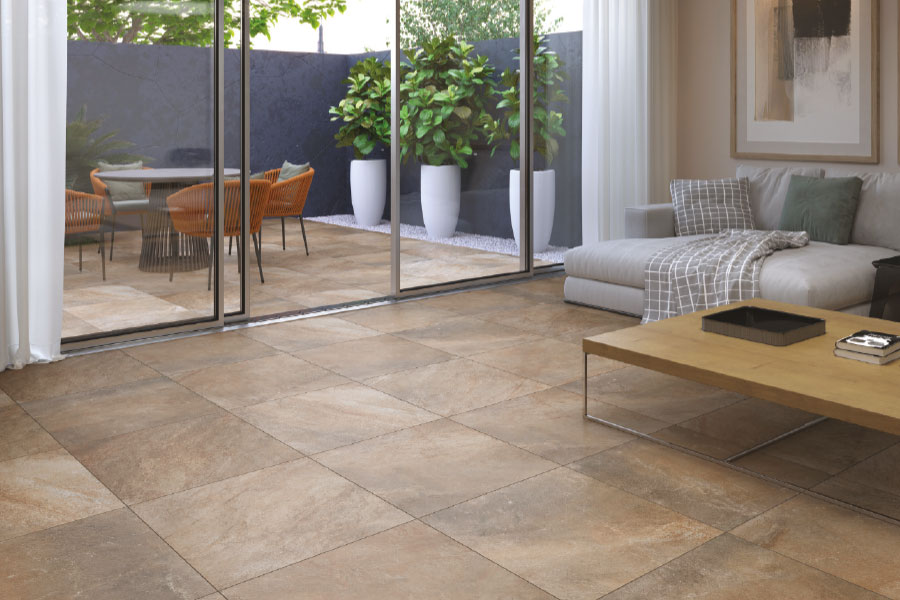
Much more closely than they used to. Customers actively ask for continuity from kitchen/dining spaces out onto the patio to promote their outdoor space, on making it a functional and inviting extension of your indoor living area, and designated activity zones. The industry has responded by promoting the ‘inside/outside’ concept rather than a one-off request. Tile Mountain is merchandising this directly through its Indoor & Outdoor tile range to support seamless transitions. You can also see this at product level where we have several outdoor slabs that are specifically positioned as having complementary indoor tiles for a like-for-like look across thresholds.
What key technical performance features are customers and specifiers prioritising when selecting exterior tiles?
The priority list is very consistent:
– Slip resistance is the dominant requirement for outdoor floors
– 20mm thickness for slab applications, as it’s associated with robustness underfoot and suitability for exterior laying methods. Having said this, 10mm anti-slip porcelain is equally as effective when installing to a solid concrete substrate.
– Weather performance: frost/UK weather suitability and general ‘outdoor-proof’ performance are non-negotiables for buyers.
– Rectified edges and multiple faces are also increasingly important for the finished modern look, although we are seeing a growing trend for distressed chiselled & tumbled edges replicating a natural product along with the benefits of porcelain.
How well informed are customers about the specific requirements of exterior installations, and where do you see the biggest knowledge gaps?
Knowledge is improving, but the biggest gaps tend to be around installation build-ups and systems, rather than tile selection.
Common pinch points are:
– Understanding that outdoor porcelain needs the right substrate preparation and compatible fixing materials for example priming slurry where needed, correct exterior adhesives or mortars where applicable, grouts and sealers.
– Alternative installation methods, such as laying 20mm slabs onto a hardcore base / MOT Type 2 with a dedicated system installation approach, or using pedestal systems in certain settings over the classic installation onto a concrete base.
What role do installers play in influencing product choice for outdoor tiling projects, and has this increased in recent years?
Installers and landscapers have a major influence because exterior projects often sit at the crossover of tiling, groundworks and drainage. In practice, many customers shortlist visually, but the final decision is shaped by what an installer is confident fitting, what works with the intended sub-base, and what will stand up long-term in exposure conditions. That influence has increased as outdoor slabs and ‘inside/out’ projects have become more mainstream, customers are more likely to involve a professional earlier, especially when they’re trying to align levels at thresholds or create large-format layouts with minimal cuts.
Is sustainability becoming a more important factor when customers choose exterior tiles, or does performance still take priority?
Product performance still leads, especially slip resistance and weather suitability, however sustainability is starting to show up more as a secondary consideration. In outdoor, it often comes through in practical decision-making: customers like materials that don’t need ongoing sealing and are straightforward to maintain over time.
Looking ahead, what trends do you expect to shape the exterior tile market over the next 12–24 months?
A few clear directions:
– More indoor/outdoor seamless coordinating tiles: continuity across thresholds will keep growing, and ranges will continue to be built with ‘companion’ indoor formats/finishes.
– Large-format will remain dominant
– Warmer neutrals continuing to gain share alongside grey
– Chiseled and/or tumbled edge porcelain tiles replicating the feel and look of natural stone
– Rectified edges still remain a big part of the outdoor porcelain market
www.tilemountain.co.uk
Jeremy Harris is managing director, Tile Mountain