
Harriet Goodacre, style and interiors consultant at Topps, as well as Jeremy Harris, MD of Tile Mountain, shared their thoughts on a range of topics, including whether large format is still gaining market share, contemporary design trends, and potential drawbacks to the category.
Are large format tiles still gaining popularity in 2026?
Harriet: “Large format tiles are a really popular choice amongst consumers, and our own sales figures show this with some interesting regional differences in demand. We recently analysed more than 669,000 in store transactions across Britain during 2026, and found that sales of large format tiles in the North West had increased by 24% year on year, the strongest growth of any region.
“West London is another interesting example, with large and extra large tiles accounting for 48% of sales in the area by value, the highest proportion anywhere in Britain. Extra large tile sales in this area were also up 13% compared with the previous year. This demonstrates that there’s real appetite for larger tiles, especially for those looking for a contemporary and minimalist style, but also because large tiles come in so many different finishes and designs, so they can suit quite a wide range of styles and projects.”
Jeremy: “Large-format tiles continue to be a strong part of the market, particularly in stone-effect porcelain. Their appeal goes beyond size; they suit the wider demand for natural finishes and interiors that feel cohesive, with fewer visual breaks between surfaces and adjoining rooms.
“Formats such as 1200 x 600mm offer plenty of design impact across both walls and floors, while 1200 x 1200mm tiles take that further on larger floor areas. There’s a distinction between choosing a larger tile to suit the space and simply choosing the biggest available. The most successful schemes consider the format, finish and layout together.”
Where do you most commonly see large formats specified? What types of projects?
Jeremy: “From our retail perspective, kitchens, bathrooms and open-plan living areas are key applications. Renovations and extensions lend themselves particularly well to larger floor tiles, where using the same design across the kitchen, dining and living areas helps bring the scheme together. Large-format porcelain tiles are also an ideal partner for underfloor heating, thanks to porcelain’s ability to conduct heat efficiently.
“In bathrooms, larger wall tiles allow a stone or marble effect to become a feature in its own right, particularly across shower walls. They can also work in smaller bathrooms, although that depends on the layout and positioning of cuts. Room size alone shouldn’t determine tile size.”
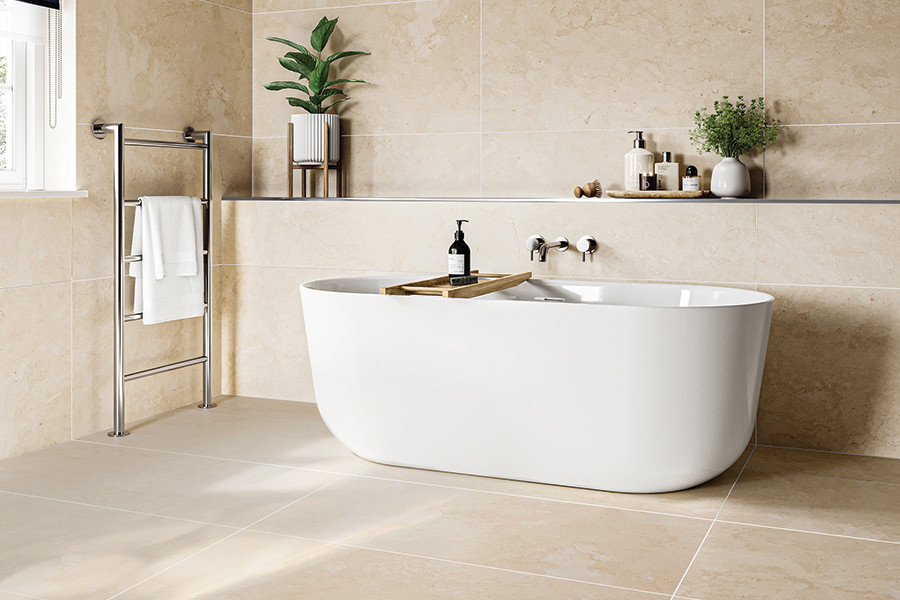
Harriet: “Bathrooms and open plan kitchens and living areas are prime spaces for larger formats, especially where you’re trying to create a continuous finish. They’re also a great option for shower walls, where fewer grout lines can make a real difference to the overall look of the room, creating a spa-like feel. But I wouldn’t rule them out for smaller rooms either. A large format tile can work really well in a compact bathroom as you have fewer grout lines breaking up the walls or floor and distracting your eye line, which can make the space feel less busy.
“I’d always advise looking at the layout of the room rather than just its size. A smaller room with an uninterrupted, straight wall might work well with a large tile, whereas a bigger space with lots of awkward corners, recesses or pipework might need a different approach.”
What design trends are you seeing in large format tiles?
Harriet: “Natural stone effects are a big part of what we’re seeing, particularly warmer limestone, marble and travertine looks, alongside onyx designs. There’s still a place for more industrial styles, such as concrete effects, but we’re seeing more interest in finishes with much more warmth, texture and natural looking variation.
“This is perhaps down to how much more realistic effect style tiles are becoming. With a larger tile, you have much more uninterrupted surface on show, so the detail of this really matters. Good quality large format tiles have subtle variation between each individual tile, so you don’t end up with an obvious repeating pattern across a large floor or wall and it looks more natural.
“We’re also seeing more surface textures that follow the printed pattern or veining of the tile, rather than just sitting on top of it. It adds another dimension to the finish and gives more choice than simply opting for matt or polished versions.”
Jeremy: “Warm stone effects are a strong direction, with ivory, beige and sand tones bringing a softer feel to large tiled areas. Limestone and travertine effects fit particularly well with this, offering natural variation without dominating the room. Matt finishes complement that more understated approach.
“There’s also room for more expressive marble and onyx effects, including warmer veining and coloured designs. A larger tile gives those details space to make an impact. The distinction is between customers wanting a quiet, consistent backdrop and those using the tile as the main decorative feature; large formats can serve both.”
What advantages do large format tiles offer over more traditional dimensions?
Jeremy: “Fewer grout lines create a less interrupted surface, which is particularly effective across open-plan floors or larger expanses of wall. With stone and marble effects, this also allows more of the design to be appreciated within each tile.
“There’s less grout to maintain across the same area, which adds a practical benefit. From a design perspective, larger formats can help connect different parts of a scheme without needing additional decorative detail. That doesn’t remove the place for smaller tiles, but it gives customers another way to introduce character through the surface itself.”
Harriet: “The biggest advantage is probably the more seamless, sleek look and finish you can achieve. Larger tiles mean fewer grout lines, so the line of sight isn’t constantly being interrupted, which works particularly well with marble and other natural stone effects where you want to see that natural look and pattern across a larger surface.
“There’s also a practical benefit because fewer grout joints mean less grout to keep clean, particularly in bathrooms and showers. And I think there’s more flexibility with this type of tile than people realise. You can use larger tiles to make a smaller room feel less cluttered, or carry the same tile across walls and floors to create a more cohesive look. Plus, you can create cohesion by carrying the same tile from the indoors through to the outside, providing it’s outdoor safe and slip resistant, for a flawless finish. It’s not necessarily about making a statement with the size of the tile itself, but about the overall finish you’re trying to achieve.”
Are there any drawbacks to large format tiles?
Harriet: “There’s a few practical things to consider such as the fact larger tiles are less forgiving of uneven surfaces, so you need to make sure the walls or floor are properly prepared before you start tiling. You may find that you need extra preparation to make sure everything is level before tiling begins, but it’s always worth putting in that extra groundwork to get the job right.
“You also need to consider the weight and size of the tiles. Large tiles are heavier and more rigid than smaller ones, so you need to make sure the walls can safely support the weight of them. For installers, the right equipment, suitable adhesives and achieving the correct adhesive coverage are all important.
“It’s also important to think about the overall layout of the space before selecting a particular size, as awkward corners, lots of cuts or changes in floor level can make a larger format less practical.”
Jeremy: “Installation costs need to be considered alongside the tile price. Larger formats are less forgiving of deviations in the substrate, and handling and cutting requirements can add to labour and equipment costs. Fewer tiles per square metre doesn’t necessarily mean a quicker installation.
Layout also becomes more critical, particularly in smaller rooms or spaces with numerous fittings. Cuts can have a greater impact on both the finished appearance and material wastage, so the largest available format won’t always be the most appropriate choice.”
Are there any brands or ranges you’d point to as the cutting edge in large format?
Harriet: “Our Inigo collection, which comes in a 60 x 120cm format, is a really versatile and stylish larger format tile. It uses carving inks that follow the veining of the stone effect, creating a subtle texture in the surface rather than relying on the printed design alone. There are also six different tile faces, which helps introduce more natural variation when the tiles are laid across a larger area.
“Another good example is our Torrano Calacatta 2.0, also in a 60 x 120cm size. Inspired by Italian Calacatta marble, the original collection launched several years ago, but advances in tile manufacturing technology have allowed us to update the design for an even more authentic look. The updated veining patterns give the polished surface a more natural flow, while six different face variations help create a more realistic finish. It also has rectified edges which create a neat, precise finish.
“I think both are good examples of how large format tiles are developing. It’s not just about producing bigger tiles, but making the designs more realistic and giving people more choice when it comes to the finish and texture of the surface.”