

Decocer specialises exclusively in the design and manufacture of small-format ceramic tiles, combining artisanal expertise with advanced production technologies, the manufacturer says, to offer architects and interior designer’s exceptional freedom in colour, geometry, texture and composition.
Today, with around 75% of its turnover generated in international markets, Decocer has established itself as one of Europe’s specialists in premium small-format ceramics. Rather than treating ceramics simply as a surface finish, the company says it approaches them as an architectural language capable of shaping space, rhythm and material expression. This philosophy is reflected in two of its latest collections, TALYA and LYTHOS, which reinterpret different architectural traditions through a contemporary lens.
TALYA: Rediscovering the beauty of craftsmanship
Inspired by the rich heritage of zellige, TALYA celebrates the authenticity of handcrafted ceramics through deep glossy glazes, subtle irregularities and a carefully curated colour palette. Instead of pursuing perfect uniformity, the collection embraces variation, allowing light to reveal ever-changing reflections and visual depth that bring warmth and character to contemporary interiors.
Available in 5x15cm and 10x10cm formats, TALYA is said to demonstrate the expressive potential of small-format ceramics. Its versatile formats, laying patterns and ten carefully selected shades allow architects and interior designers to create compositions ranging from understated elegance to more vibrant and decorative schemes. Rather than replicating traditional craftsmanship, TALYA translates its tactile richness into a contemporary architectural language suited to residential, hospitality and commercial projects.
LYTHOS: Geometry as an architectural language
While TALYA explores craftsmanship and light, LYTHOS is driven by geometry and composition.
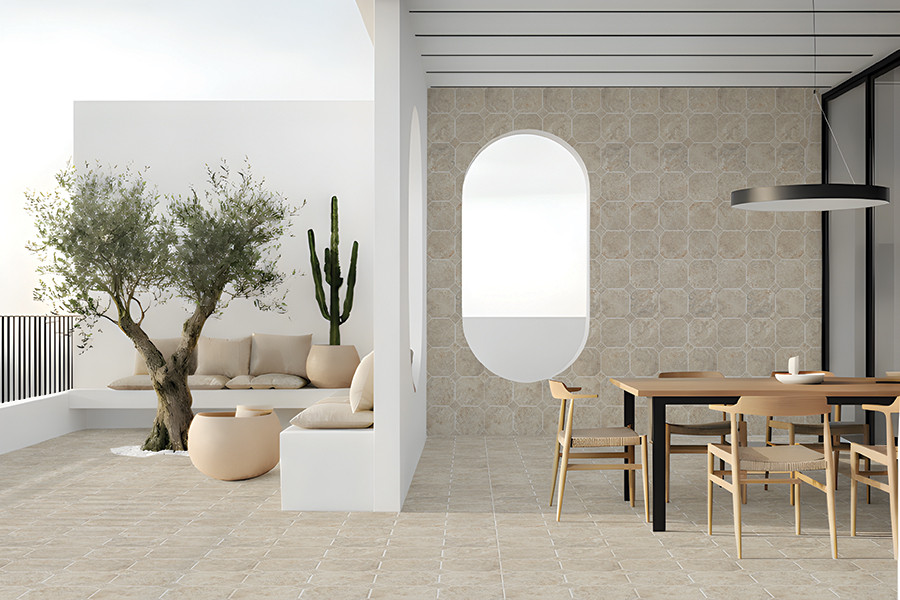
Inspired by the compositional tradition of historic stone pavements, the collection translates this architectural heritage into a contemporary ceramic system. Built around four complementary geometries – octagon, star, cross and insert – LYTHOS unlocks the creative possibilities of small-format ceramics, enabling architects and designers to generate multiple layouts from a limited number of elements.
Its palette of White, Sand, Grey and Dark Grey, combined with a mineral matt finish, reinforces the clarity of each composition while allowing geometry to become the defining feature of the design, says Decocer. Manufactured in porcelain with C3 slip resistance, LYTHOS is suitable for both interior and exterior applications, making it equally appropriate for residential, hospitality and commercial environments.
Tradition as a source of innovation
Although TALYA and LYTHOS express two distinct design languages, they are said to share a common philosophy. One draws inspiration from the handcrafted richness of glazed ceramics; the other from the compositional intelligence of classical paving. Together, they demonstrate that tradition does not need to be reproduced literally to remain relevant. Instead, it can become a source of ideas capable of responding to the needs of contemporary architecture.
More broadly, both collections reflect the evolving role of ceramics within architectural design. Surfaces are no longer conceived simply as finishes, the manufacturer argues, but as active elements capable of shaping light, rhythm, texture and atmosphere. Whether through the luminous depth of TALYA or the modular precision of LYTHOS, ceramics become an integral part of the architectural narrative.
Through collections such as TALYA and LYTHOS, DECOCER continues to demonstrate how small-format ceramics can combine technical performance, creative freedom and timeless design. By transforming architectural references into contemporary design tools, the company reaffirms its commitment to innovation while expanding the creative possibilities of ceramic surfaces.