

Of all tiling jobs, wetrooms are among the areas where problems are most likely to occur. The risk of water getting into the substrate and causing failure of an incorrect installation is significant. Following correct procedures and using Palace Chemicals products will help ensure that any wetroom project is a success, the company says.
A wetroom is considered to be an installation where the drain or gully is set to either the same or near to the level of the floor. The popularity of these in both domestic and commercial applications continues to increase. Good structural design, including water-resistant background materials, high quality tiles, grouts and adhesives, as well as correct pre-installation surface sealing methods are all important to achieving a safe and long-lasting wetroom.
Palace Chemicals offers a range of wetroom products, all designed to ensure a successful installation. Key products from the range include the PALACE SHOWER-TIGHT kit. This is a waterproof barrier system, developed to protect sensitive substrates in tiled areas such as showers, bathrooms, wet-rooms and kitchen utility areas. It is a complete kit, ideally suited for tanking a single shower cubicle or an over-bath shower.
The system consists of a 1 litre primer, 2.5 litres grey flexible latex waterproof coating, 1sqm super strong polyester mat, complete with 10m of polyester tape to reinforce seams in joints around wall/floor junctions along with all corners. This seamless, protective membrane inhibits the passage of moisture from within the tiled area through to surfaces and structures which may be sensitive to the effects of prolonged water migration. In total it provides 4sqm coverage.
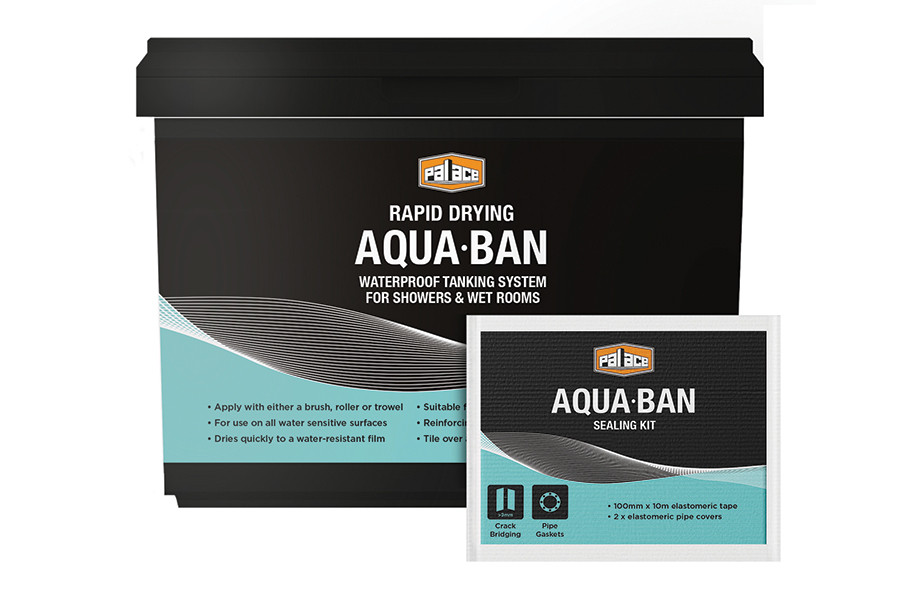
If a full wetroom installation is being undertaken, then PALACE AQUA-BAN is the best product to use. This is a waterproof membrane system designed to protect tiled areas in locations such as wet-rooms, commercial or domestic showers, bathrooms, and swimming pools. PALACE AQUA-BAN will provide a complete waterproof barrier behind the tiled area, into all types of substrates such as plaster, render, plasterboard, tile backer boards, timber, suspended floors, concrete floors and plywood overlays.
This is a 7kg, grey flexible latex waterproof coating, that has the ability to bridge cracks or joints less than 3mm, bond to plastic and metal and replicate the weight loading capabilities of the receiving substrate without the use of an additional primer.
To ensure a complete system approach, the PALACE AQUA-BAN SEALING KIT should also be used, which consists of two rubber/polyester pipe covers and a 10m length of elastomeric reinforcing tape to reinforce seams in joints around wall/floor junctions where the gaps are larger than 3mm. The overall coverage is 7-8sqm and can enable tiling or flood testing around 2 hours after installation.
The built-in flexibility of both systems will accommodate a level of movement and vibration, providing a solvent-free base for fixing wall and floor tiles. Both types of reinforcing tapes provides crack-bridging protection for all wall and floor joints.
The key points when tiling surfaces within a wetroom enclosure is that the structure itself and all associated joints around perimeters, trays, drains and pipe entry points should be protected with a waterproof sealant to inhibit the free passage of moisture from within the wet zone. All surfaces subject to load should be stable and ideally free from movement. This is true whatever the nature of the substrate, but it is particularly important, given that many existing internal walls are commonly based on plaster or plasterboard over timber floor structures, all of which are susceptible to damage if they become frequently wet.
Guidance provided by BS5385 Parts 1-4 4 advises that a tiled surface will not of itself provide a fully waterproof layer. Protection for vulnerable substrates and structures beneath the tiling can ideally be achieved with the application of a water-tight tanking system. Furthermore, any area that is subjected to getting wet (shower, steam room, wet rooms etc) should be tanked – whether it be a new build or refurbishment of an existing area.
www.palacechemicals.co.uk
How to achieve a successful wetroom installation with Palace Chemicals products
Please click to view more articles about
> Palace Chemicals <