
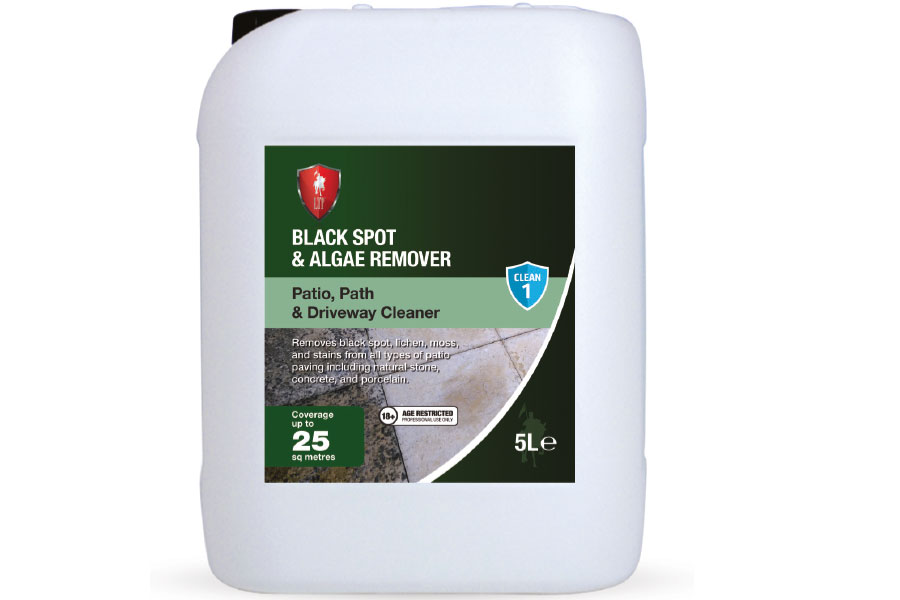
A BUILD-UP of algae on paths, steps, driveways and patios creates a slippery residue and a hazard underfoot. Algae tends to flourish in damp, shady and humid areas and, in the UK, build-up is especially common in the winter. LTP provides the solution with Black Spot & Algae Remover – an acid-free treatment that safely restores safety and appearance to all types of pavers, including acid-sensitive natural stone, concrete, brick and porcelain, says LTP. The treatment is easy to apply and is said to give results in as little as two hours.
Different types of algae
Often forming a dark green or black jelly-like film, slippery algae is generally caused by a cyanobacteria called Nostoc. Black spot – a dust-like lichen that originates from plants and trees – can also form a slippery residue; it takes about two-three years to become established, sending tendrils or ‘hyphae’ down into any cracks or porosity, searching for nutrients. Other forms of algae, like moss, liverwort and lichen tend not to be such a hazard, although widespread growth might not be welcome from an aesthetic point-of-view.
Removing slippery residue
LTP Black Spot & Algae Remover is said to remove all types of algae, along with dirt and other residue. It’s applied neat to swept pavers using a watering can or light pressure garden sprayer, and left to act for up to four hours.
LTP adds: ‘The formula breaks down residue and removes stains. Most stains are removed within hours of application. Exposure to the air for four hours or longer ensures the potency of the product has diminished before hosing surfaces down with clean water. This helps to ensure that diluted wash-off is as harmless as possible to plants and lawns. The remover can be used on dry and slightly damp surfaces and should be applied during a morning or afternoon of fair weather.’
A pressure washer shouldn’t be used to remove algae and residue, as excessive water will encourage further growth, damage pavers and any sealer applied and it will loosen grout. Water alone also won’t target hyphae or filaments anchored into place below the surface. Acidic solutions should also be avoided, as these will damage acid sensitive material and erode cementitious grout joints.
After treatment, newly cleaned surfaces can be protected with LTP External Stone Sealer, LTP Porcelain Protector or LTP Porcelain Tile Enhancer. These treatments are said by the company to create a barrier that helps prevent absorption of moisture and organic particles, reducing staining and the spread of algae, mould and black spot.
01823 666213
info@ltp-online.co.uk
www.ltp-online.co.uk