
Randall Fisher Introduces his company CERAMIC TILE SYSTEMS (Northern) Ltd, based in Carlisle, Cumbria and the challenges facing small independent businesses involved in the ceramic industry.
Q: Please introduce yourself and how you became involved in the Ceramic industry.
A: Hi all, my name is Randall and I have been involved in the ceramic industry in various capacities for over 30 years. I joined the British Army straight from school at 16 years old and served for 12 years in various theatres all over the world. My mother was a partner in an import agency that the more mature readers may remember, Clifford Import Agents, who at the time were agents for various Italian manufacturers and were looking to expand and take on Spanish factories. I jumped at the chance to leave and join the company and spent the next 20 years as an agent for various Italian & Spanish factories.
Q: For readers less familiar with Ceramic Tile Systems, could you introduce the company and share what sits at the heart of the business.
A: We’re based in Carlisle, literally 2 minutes from J44 of the M6. We have a 13,000sq ft footprint, shared between warehouse storage and retail showroom. Our primary business is distribution throughout Scotland and the North of England and North Wales, although we do have customers all over the UK, those that I have kept in touch with from my days of being an agent. We are most probably best known for the distribution of small formats, i.e. metro or kitchen tiles as they are most commonly known. We run a very simple but effective system, samples or fixed display material are supplied to showrooms and when an order is received and sent to us, they are despatched on an overnight courier. Orders received up until 1500 are despatched for next day delivery for anywhere in the UK. As I said, it’s very simple but efficient. Good stock levels are kept from leading manufacturers in Italy and Spain. As well as the small formats, as time has gone by, we have introduced into stock more and more every day formats from 30×60 up to 60×120, again we can provide next day delivery for orders received up until 1500. As well as our distribution, we have a large showroom with large fixed displays showing all the latest designs and formats. Just recently we have added a bathroom showroom with leading sanitary ware manufacturers. Approximately 75% of the displays are in stock ready to take away as well as all the sundries needed for substrates and fixing.
Q: How has the company evolved alongside changes in the tile industry?
A: The business was created in 2010, sharing a warehouse with a local hardware company, we started distributing polished porcelain from China. Back then it was an emerging product and did very well until the Anti-Dumping duty measures were brought in. At that point we didn’t have a showroom. Looking to diversify and stay away from the general distribution items already awash in the market, we turned to mosaics and operated a system very similar to the small format system we run now, mosaics were stocked in depth in Carlisle, displays in showrooms and orders despatched on an overnight basis. That trend continued for a number of years and was very, very successful. However I have never seen a trend or fashion end so quickly, it was almost over-night that demand waned and we had to diversify again, turning to the small formats that we still distribute now. We moved premises in 2012 as both companies were growing and more space was needed and then the showroom came along, serving local retail and trade customers.
Q: What key trends are you seeing in tile design, in terms of styles, formats and finishes?
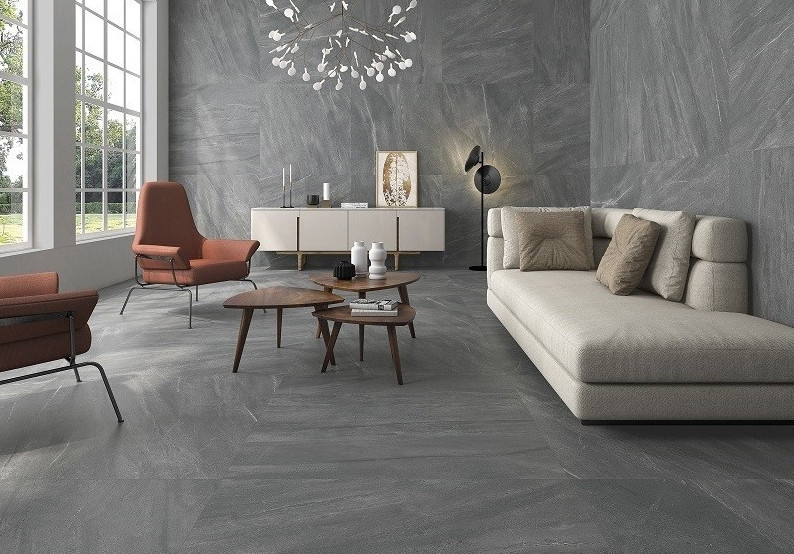
A: Trends have shifted quickly in recent years and at the moment it seems to be one extreme to the other. Small formats are very popular, once limited to kitchen or sink splashbacks, are now being widely used in bathrooms or other applications. The beauty of the smaller tile is their versatility, they can be fixed in various ways, a tiler’s headache, herringbone being particularly popular at the moment. It is also a way to introduce colour to any scheme, something harder to do with the larger formats. On the other hand, larger formats from 600×1200 and upward to slab sizes are also gaining traction in the market, particularly 600×1200 which is now an everyday format, less grout lines and seamless patterns being only a couple of benefits, who would have thought that four or five years ago? I can recall when people were horrified when 300×600 came out! From visiting Cersaie and factories every year since 1995, seeing the evolution of the ceramic industry really has been incredible.
Q: What are the main challenges facing tile suppliers and installers?
A: Costs basically, they have increased relentlessly across the board, not only in the UK, but across Europe. Continuing economic difficulties and uncertainty have posed the biggest threat to the ceramic industry. As I write this, due to the crisis in the Middle East, only today did I receive notice from one manufacturer that an energy surcharge of 5% would be applicable from a certain date, certainly there will be more to come if the war continues as it is. The difficulties being experienced are not only down to increased material and transportation costs, but also to increases in National Insurance and the minimum wage, they all contribute to a knock-on effect.
Whilst the issues mentioned are being experienced by many industries, they have a bearing on how the consumer makes decisions and it is extremely unfortunate to see some very well known and long established names in the tile industry go into administration in 2025.
A major issue at the moment, and has been for some time now, is the introduction of Indian material to the market, especially in the 600×1200 polished and 20mm material. Prices being banded about on the internet and social media are ridiculously low and just devalues our product. How difficult is it to justify a 300×600 from Italy or Spain at £50sq m or similar and then a 600×1200 polished tile from India at £20sq m or similar!
Q: In an increasingly digital world, what role doe the physical showroom continue to play?
A: In my opinion a showroom is essential. Purchasing a tile online can be very easy, but in my opinion quite risky. Can the colour, texture or pattern be judged correctly from a swatch measuring approx. 10x10cm? Obviously it can be in many instances as the online retailers seem to be growing in popularity but I’m probably old fashioned, tiles are a touchy, feely thing! There’s an old saying, use it or lose it, and I tend to think this is applicable to the small independent businesses like Ceramic Tile Systems. You probably can buy cheaper online but is service and expertise there that your local supplier can 9 times out of 10 offer you.
Q: Have you noticed shifts in customer expectations and buying behaviour?
A: Decisions now take a lot longer than previously. Customers will visit showrooms multiple times before making a decision, often influenced by what they have seen on the internet from sites such as Pinterest etc etc and comparing showroom displays to swatches they have bought from online retailers. Very common is the taking of pictures and the names of tiles on show to compare online, to combat this we change the names of all our products to hide their true identity.
Q: Supporting the trade remains important. In your opinion, how does CTS support this?
A: Through the showroom, we stock everything needed for the installation of floor and wall tiles as do most retail outlets. However, of late, we have seen quite a dip in sales of sundries such as adhesives and grouts, largely due to online retailers. These e-commerce sites offer prices that small independents just can’t compete with and receive considerable rebates. For me, that just devalues the product and makes ‘profit’ seem like a dirty word.
Q: Looking ahead, what opportunities or developments excite you for CTS?
A: We aim to increase our customer base while maintaining the high level of service we are known for, it seems to be human nature to remember when something goes wrong, not when it goes right, so maintaining excellent service is vital. Every customer has different requirements, and being able to adapt to each one is essential. Ultimately we focus on what we can control, supporting customers, locally & nationally, staying up with industry trends and providing a level of service that differentiates us from competitors. Technology, trends and customer expectations will continue to evolve but staying committed to quality and service will hopefully ensure that we remain a strong player in the UK tile sector.
www.ceramictilesystems.co.uk