
Alessandro Mastracci, sales director at Florim (regions: Northern & Eastern Europe, Middle East, Africa, IN-PK) talks about the technology that goes into manufacturing thin porcelain tiles.
THIN porcelain tiles have become one of the most significant developments in contemporary ceramic manufacturing, combining material efficiency, technical performance and architectural versatility. Their evolution is the result of continuous technological innovation across the entire production process, driven by the need to reduce thickness without compromising strength, durability and aesthetic quality.
At the core of thin porcelain tile manufacturing is the careful engineering of the ceramic body. Achieving reduced thickness while maintaining mechanical strength requires carefully selected raw materials and mineral components that guarantee compactness and resistance – even at thicknesses of 3-6 mm.
Advanced pressing technologies play a decisive role. Large-format thin slabs are produced using presses that apply uniform pressure across the entire surface, reducing internal stress and ensuring consistency. In some cases, reinforcing systems such as fibreglass mesh applied to the back of the slab further increase impact resistance and handling safety, especially for very large formats.
The firing process demands equally high levels of precision. Thin porcelain tiles require carefully controlled firing curves and uniform temperature distribution to prevent deformation and guarantee flatness. Modern kilns, equipped with advanced monitoring systems, allow manufacturers to optimise firing cycles while reducing energy consumption.
Surface technology is another key area of innovation. High-definition digital printing and three-dimensional applications enable the creation of highly detailed surfaces that faithfully reinterpret natural materials such as stone, marble, concrete, metal, plaster, etc. These layered decorative techniques generate depth, texture and tonal variation without adding material thickness, making thin slabs visually expressive and technically efficient.
Beyond aesthetics, surface treatments are increasingly engineered to enhance performance. Anti-slip properties, improved scratch and stain resistance, and hygienic or antibacterial finishes can all be integrated into thin porcelain tiles, expanding their suitability across residential, commercial and hospitality environments, for both wall and floor applications.
Sustainability is a central driver behind the development of thin porcelain tiles. Reduced thickness translates into lower raw material consumption per sq m and reduced energy use during production. Lighter products also improve transport efficiency, cutting emissions across the supply chain.
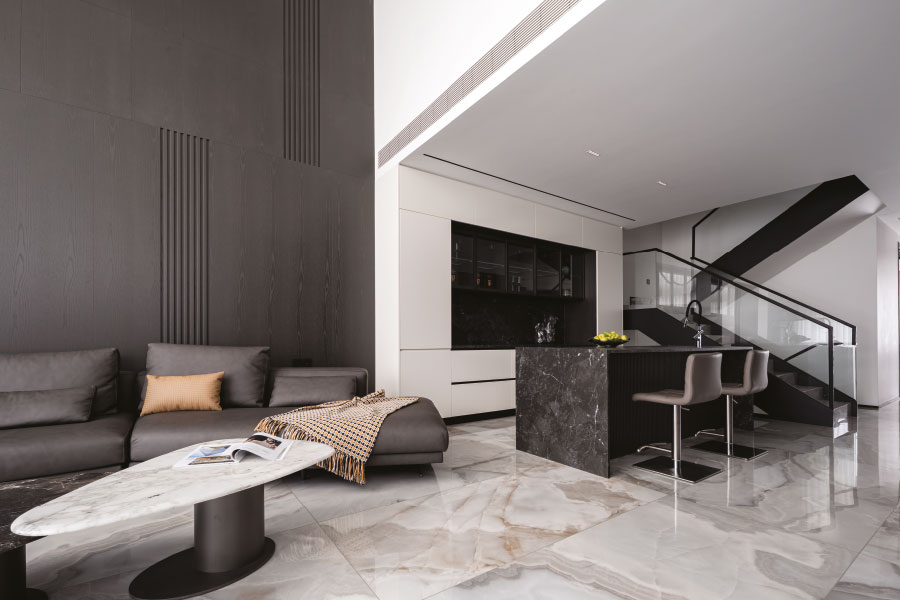
Florim interprets this technological evolution through a comprehensive slab system that articulates thickness, format and surface performance as part of a coherent architectural language. The company’s porcelain slabs are available in 3, 6, 12 and 20mm thicknesses, enabling a seamless transition from wall applications and structural floor solutions and outdoor installations. This dimensional versatility is further enhanced by a range of surface finishes – from glossy effects to structured anti-slip textures – enabling designers to calibrate aesthetic impact and technical performance within a cohesive material identity. By offering multiple thicknesses and finishes within the same collections, Florim makes it possible to maintain visual continuity across different functional contexts while selecting the most appropriate mechanical resistance and surface characteristics for each application. In this sense, thin porcelain tiles represent not only a technical achievement but a mature synthesis of technology, design and sustainability. Their development reflects a broader shift within the ceramic industry towards lighter, more versatile and more responsible materials – surfaces that respond to contemporary architectural needs while opening new possibilities for creative expression.
At Florim, the industrial processes reflect a broader commitment to responsible manufacturing. The company – a Benefit Corporation and certified B Corp – generates up to 100% of the electricity required to power its Italian production plants. When additional energy is needed, it is purchased exclusively from certified renewable sources.
An important dimension in the evolution of porcelain tiles is also the role of collaboration. For Florim, partnerships with architects and designers have been instrumental in shaping not only the aesthetic direction of collections, but also their technical development. These collaborations introduce new perspectives on material expression, scale and application, influencing everything from surface textures to formats and thicknesses. The dialogue between industrial expertise and design vision creates a productive contamination, where poetic intent and technological innovation inform each other.
Thin porcelain tiles also offer practical benefits in construction and renovation. Their reduced weight and thickness make them ideal for over-tiling existing surfaces, minimising demolition, shortening installation times and reducing overall project impact.
Today, thin porcelain tiles represent a mature synthesis of technology, design and sustainability. Their development reflects a broader shift within the ceramic industry towards lighter, more versatile and more responsible materials – surfaces that respond to contemporary architectural needs while opening new possibilities for creative expression.