

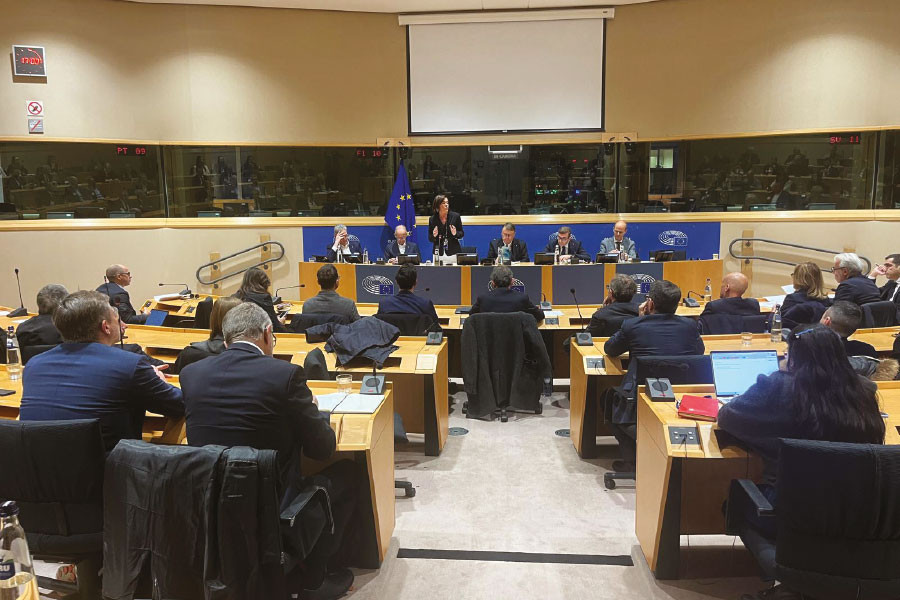
ON 2 and 3 December, the senior management of Confindustria Ceramica, together with representatives of the leading companies in the sector, were in Brussels for a series of meetings with key decision-makers in European institutions. The aim was to explain how the Italian ceramic industry, a strongly export-oriented, risks entering a systemic crisis within a few years unless urgent, targeted action is taken, says Confindustria Ceramica.
The industry currently consists of 248 companies, employs 26,000 people directly (40,000 including the supply chain) and generates more than €6.3 billion in exports. Yet its stability is being undermined by a combination of uncontrolled costs and an increasingly unsustainable regulatory framework.
The message from the Italian ceramic industry is clear: the current climate policy framework, combined with the soaring costs of the ETS, is rapidly eroding the competitiveness, investment capacity and employment prospects of the entire sector. Without an immediate review of European rules, deadlines and instruments, there’s a very real risk of the progressive closure of European plants and the relocation of production to non-EU countries that don’t have comparable environmental and social standards, says the company.
The delegation, accompanied by the president of the Emilia-Romagna regional government, Michele De Pascale, and Confindustria delegate for Energy, Aurelio Regina, met Raffaele Fitto, executive vice-president of the European Commission, along with other senior representatives of the EU institutions.
The meetings coincide with the annual plenary session of the European Policy Ceramics Forum (EPCF), which brings together MEPs from various member states that are particularly exposed to the challenges facing the European ceramic industry.
‘Our sector is also a world leader in terms of efficiency and emissions reduction thanks to investments totalling €4.3 billion over the last decade,’ said Augusto Ciarrocchi, chairman of Confindustria Ceramica. ‘But we now have reached a breaking point. The lack of realistic technological alternatives, together with the uncontrolled rise in ETS costs, risks cancelling out in a very short time everything we have built. The ETS system has effectively become a carbon tax that’s suffocating our ability to invest. In just one year, investments in the sector have fallen by 20%, a decrease of €80 million that corresponds to the ETS costs paid by our companies and puts competitiveness and jobs at risk. Without immediate corrective measures, Europe will end up rewarding those who pollute outside its borders and penalising those who, like us, are genuinely investing in the environment.’
Graziano Verdi, chairman of the European federation CET, gave an even starker warning: ‘Without swift and decisive action, the Italian ceramic sector will face a crisis similar to, if not worse than, that of the automotive industry. In the absence of corrective measures, competition from non-EU countries without any environmental constraints whatsoever will become unsustainable. We aren’t asking for privileges, but for fair and common-sense rules, such as the proper application of existing compensation schemes, the suspension of mechanisms for reducing allocated quotas, a CBAM that truly protects our products in the EU and non-EU markets, and the extension of equivalent measures to smaller companies. If we fail to act now, the transition will become an industrial and social boomerang of enormous proportions.’
‘We went to Brussels to give a voice to an entire industrial district, the ceramic industry, which is a flagship not only for Emilia-Romagna but for Europe as a whole,’ said Michele de Pascale, president of the Emilia-Romagna regional government. ‘We recently held an important meeting with trade unions at the headquarters of Confindustria Ceramica, an open and responsible discussion that confirmed the urgent need for a shared strategy to protect businesses, workers and the local community.
‘The ceramic industry is a highly energy-intensive, hard-to-abate sector that has invested heavily in the ecological transition, cutting emissions and innovating processes. In Emilia-Romagna, we have some of the most advanced companies in the world, with modern, digitalised, highly efficient and sustainable plants. Penalising them with a disproportionate regulatory system, starting with the ETS mechanism, means undermining the competitiveness of the very companies that were the first to act responsibly, while at the same time benefiting non-EU countries such as China, India and Turkey, where environmental and social rules are far less stringent.
‘In this way we risk increasing global emissions instead of reducing them, while putting thousands of skilled jobs in our region at risk. Emilia-Romagna will continue to do its part, but that’s not enough on its own. Bold political decisions are needed at EU level to prevent the transition from turning into widespread deindustrialisation across Europe.’
www.confindustriaceramica.it
Please click to view more articles about
News